


















Extract Summit 2026: What Proxy Providers Should Be Paying Attention To
Arcvenza's sourced analysis of Extract Summit 2026 Austin: anti-bot evolution, ethical residential IP sourcing, TCP/IP fingerprinting and intelligent access.
 Written byYiyao
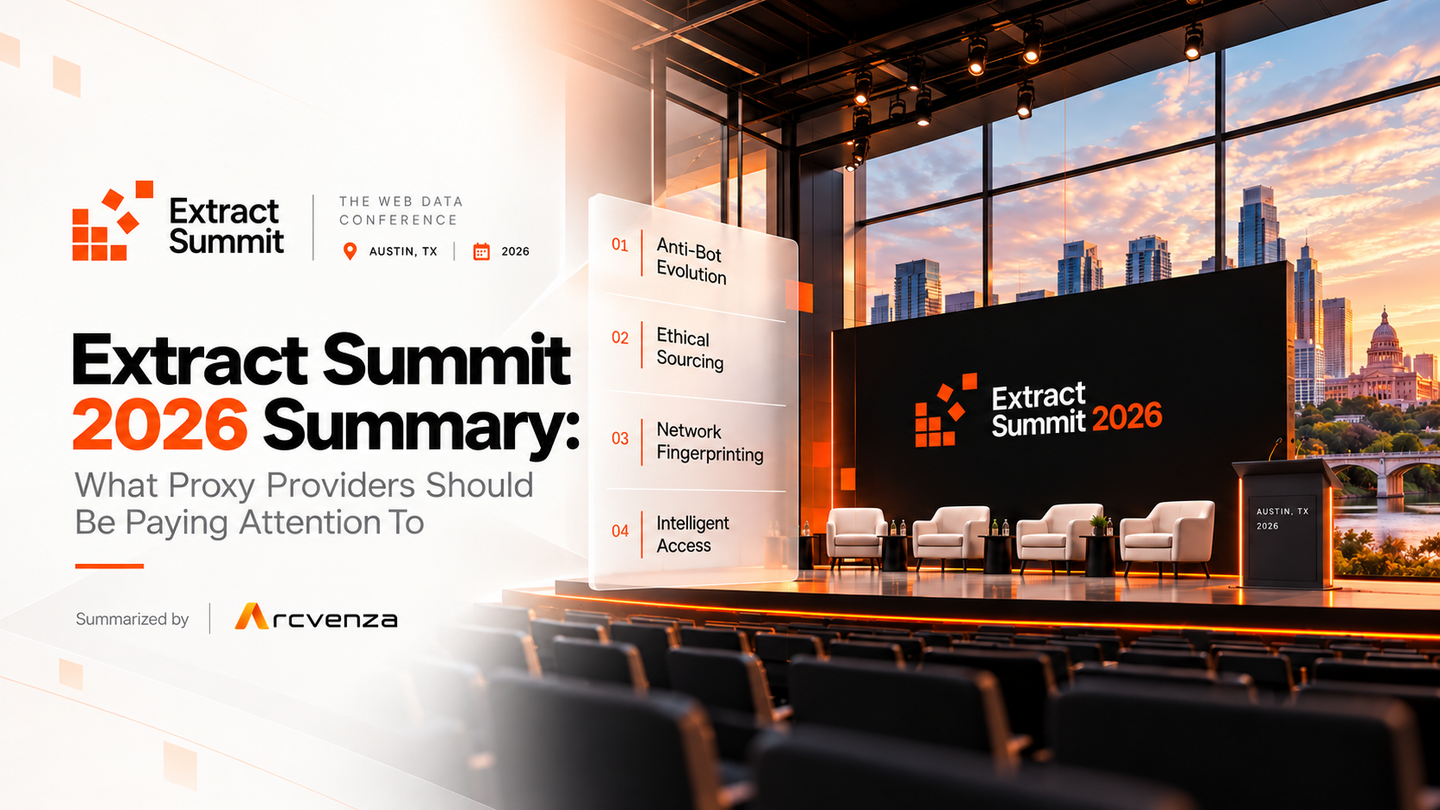
Extract Summit 2026 brought web-data practitioners to Brazos Hall in Austin, Texas, on October 7–8. Across the Austin talks, the questions facing proxy and web-access providers extended well beyond IP pool size or advertised request success. Speakers addressed increasingly layered access controls, the origin of residential IPs, network-level client identification, and systems that choose and maintain access strategies under changing conditions.
This Arcvenza analysis groups documented Austin sessions into four editorial themes. They are our synthesis—not four official conference tracks. The discussion below attributes observations to named speakers and separates event findings from the implications we draw for proxy providers.
Four themes from Austin: sessions and industry implications
| Editorial theme | Austin session and speaker | Question for proxy providers |
|---|---|---|
| Anti-Bot Evolution | The Antiban Arms Race and the Open Web — Akshay Philar, Zyte | How should access platforms respond to layered controls and agent-driven demand? |
| Ethical Sourcing | How Compliant Residential Proxy Node Sourcing Works — Jason Grad, Massive; legal panel | Can providers document informed consent, partner oversight and defensible data acquisition? |
| Network Fingerprinting | TCP/IP Fingerprinting: How It Works and How We Beat It — Joseph Dye, Byteful | Do transport-level signals contradict the identity implied by an IP or browser? |
| Intelligent Access | The Multi-Armed Bandit and Web Data — Logan Harless, String; self-repair talks by Zyte and Crawly | How can platforms optimize cost, latency and valid output while maintaining bounded, verifiable automation? |
01 — Anti-Bot Evolution
Akshay Philar of Zyte used his Austin presentation, The Antiban Arms Race and the Open Web, to describe how access controls have evolved from relatively simple filters into interconnected checks. His subsequent first-person account discusses IP reputation, TCP/TLS handshakes, browser automation signals and device-level characteristics. A request may face scrutiny at several stages before a useful page is returned.
The second pressure is demand. As AI agents retrieve and compare information on behalf of users, a single human task can generate many machine requests. Philar framed this as a tension between more capable agents and a web increasingly segmented by technical and commercial access controls. He also discussed emerging identity and authorization approaches, including Web Bot Auth, as part of the wider debate about an open web.
For proxy providers, Arcvenza's interpretation is that a large address pool alone is an incomplete answer. Operational teams need to understand which failure belongs to network connectivity, which to a browser or session layer, and which reflects an explicit access policy. Transparent error classification, sensible request budgets and permission-aware product design become more valuable than blanket claims of being unblockable.
Takeaway for providers
Treat web access as a multi-layer reliability problem. Support observability and predictable networking without presenting IP rotation as a substitute for authorization or website rules.
02 — Ethical Sourcing
Jason Grad, co-founder and CEO of Massive, centered his Austin talk on compliant residential proxy node sourcing. The conference accounts describe informed opt-in, meaningful participation controls, clean uninstallation, partner monitoring and customer vetting. The underlying principle is straightforward: residential capacity ultimately depends on end-user devices and should not be procured through hidden or misleading participation.
The Austin legal panel, featuring Zyte counsel and Scott Lashway of Mintz, added another dimension. Participants discussed differences between US and EU legal approaches and the importance of documented acquisition practices, terms of service, technical access boundaries and legal review. These discussions do not establish one universal scraping rule; they underscore that both the source of network capacity and the intended use of collected data deserve scrutiny.
The implication for proxy providers is procurement discipline. Consent should be verifiable and revocable; distribution partners and SDK integrations should be reviewed; abuse controls and acceptable-use enforcement should be documented. Buyers should be able to ask where an IP originated and what governance surrounds its participation—without assuming that merely labeling a network 'residential' answers the question.
Takeaway for providers
Build provenance and participant consent into supply-chain controls, then pair them with transparent customer screening and ongoing operational review. Ethical sourcing is a continuous process, not a marketing badge.
03 — Network Fingerprinting
Joseph Dye, technical co-founder of Byteful, delivered the explicitly titled session TCP/IP Fingerprinting: How It Works and How We Beat It. Conference reporting describes demonstrations of how operating systems produce distinguishable characteristics in TCP/IP packet behavior, and how a user-space networking implementation can affect the resulting fingerprint.
This shifts the technical conversation below the HTTP request. TCP/IP implementation details, network handshake properties and browser-level signals are different layers. Zyte's Akshay Philar also discussed JA3/JA4 TLS fingerprinting in the wider anti-bot context. The significant observation is not that one fingerprint decides every outcome, but that a credible-looking IP address does not determine the entire client identity visible to a destination.
For infrastructure operators, consistency matters: endpoint behavior, routing, client stack and telemetry all affect how network traffic is observed. Fingerprinting research is therefore relevant to compatibility testing, anomaly detection and diagnosis. It should not be interpreted as a guarantee that a particular protocol stack can reliably defeat any site's protections.
Takeaway for providers
Measure access problems at the correct layer. IP classification, TCP/IP characteristics, TLS behavior and application sessions are separate variables; collect evidence before attributing a failure to the proxy pool.
04 — Intelligent Access
Logan Harless, CTO of String, presented The Multi-Armed Bandit and Web Data. His session considered the problem of selecting among configurations whose performance changes over time. According to Zyte's event recap, each fetch involves a trade-off among cost, latency and the quality of the delivered page; choosing the most expensive strategy every time is wasteful, while freezing one low-cost configuration can fail as conditions change.
Intelligence also appeared in scraper maintenance. Zyte's Konstantin Lopukhin described an experimental crawler that detects a layout mismatch, pauses, requests a bounded agent-generated repair, verifies the result and resumes only after checks pass. Joao Drummond of Crawly described coordinated engineering agents with separation between implementation and review. These were presented as concrete experiments and workflows—not evidence that autonomous access is solved.
Crucially, access failures and extraction failures are not the same. A blocked response cannot be repaired by editing a CSS selector; conversely, a successful HTTP response may still yield incorrect or incomplete fields. The Austin discussions consistently emphasized independent verification, attempt limits, escalation and observability.
Arcvenza's operational reading is that intelligent access should be judged by useful outcomes, not only raw request success. Providers and data teams can evaluate valid records, latency, retry rate, resource usage, and cost per accepted record. Automated routing or adaptive decision systems remain subject to the destination's permissions and boundaries.
Takeaway for providers
Invest in feedback loops that distinguish connection, access and extraction quality; optimize measurable outcomes, and keep human-approved limits around automated changes.
What Arcvenza Takes Away from Extract Summit Austin
The four themes point toward a more accountable web-data infrastructure market. Anti-bot systems are becoming more layered; the legitimacy of residential supply is under closer examination; client identity extends beyond IP reputation; and access operations increasingly require data-driven decisions and verified automation.
For Arcvenza, these discussions reinforce the importance of reliable networking, transparent product constraints and responsible access. Residential, ISP and other proxy categories each address different technical needs, but none replaces permission, provenance or end-to-end data quality. That is our interpretation of the Austin conversations, not a claim of endorsement by Extract Summit, Zyte or its speakers.
Event sources and further reading
Extract Summit — official event and Austin dates
Extract Summit — Austin speaker lineup
Zyte — Five takeaways from Extract Summit 2026 Austin (October 9)
Akshay Philar — The anti-ban arms race (October 21)
Zyte — Self-healing spiders from the Austin workshop (October 22)