


















Using Your Own Proxies with a Scraping API: A Practical Guide with Arcvenza and Spicrawl
Send a request through an Arcvenza Residential Proxy with Spicrawl’s Scrape API. Check which route served the page, validate the product data, and calculate what each usable record costs.
 Written byYiyao



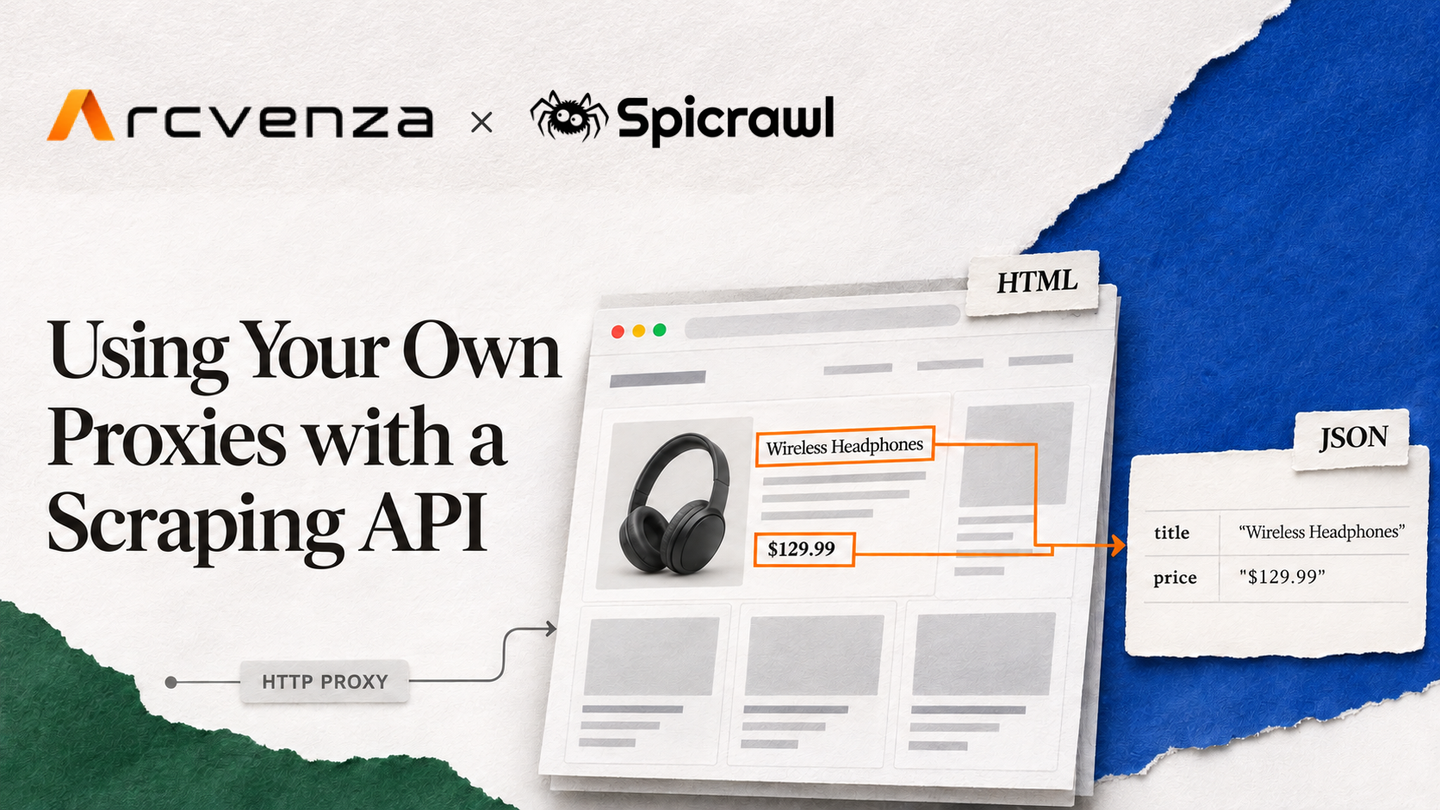
Suppose a catalog team checks a product page in two markets. A response can reach the right country yet contain the wrong currency, or return a successful HTTP status with an empty product page. With Spicrawl handling retrieval and Arcvenza Residential providing the exit IP, the team can test each result separately. The example below uses a public page you control before applying the same checks to an authorized catalog.
TL;DR Choose the exit location and session in Arcvenza. Pass the generated proxy URL in Spicrawl’s proxy field and enable proxy_verify. For the first test, disable caching, cap the request at one credit, and check for a custom route, a target HTTP 200 and a known phrase in the returned Markdown. For product data, also check the SKU, currency and price before accepting the record.
1. Understand the boundary between the API and the exit network
The request path is your application → Spicrawl Scrape API → your Arcvenza Residential proxy → the public site → Spicrawl’s response. Your application authenticates to Spicrawl with a bearer API key. Separately, Spicrawl connects to the proxy using the URL and credentials you place in the proxy field. Arcvenza’s Residential product description covers location selection, rotating or persistent sessions, and standard proxy protocols; Spicrawl’s own-proxy guide documents the proxy and proxy_verify request fields. Do not substitute an Arcvenza account API key for the generated proxy connection credentials.
Spicrawl handles the page-fetching and output layer: a plain fetch, optional JavaScript rendering, optional browser operations, Markdown conversion, and response metadata. The Arcvenza proxy handles the network route and its exit geography. Neither service grants permission to access a publisher’s content. Check source terms, an official API if one exists, and applicable robots.txt rules before collecting pages. The Robots Exclusion Protocol is a crawler instruction protocol, not a substitute for permission or a guarantee that a page is suitable for every downstream use.
This separation matters operationally. If Spicrawl returns a successful API response but the source supplied a blocked page, the API transport worked while the source outcome failed. If the proxy rejects authentication, changing Spicrawl’s rendering mode will not repair it. If a page needs JavaScript, changing IPs alone will not render the missing content. Design monitoring around the component that owns each failure.
2. Choose a Residential route for the workload
Arcvenza describes country, state, and city targeting, subject to current network coverage, along with rotating and persistent-session behavior. Pick a location because the authorized test requires it, then choose an IP-continuity model that matches the workflow. A rotating exit can be appropriate for independent public-page checks. A persistent session is more appropriate when consecutive requests must retain network identity; it remains subject to actual endpoint availability and is not a promise of an indefinitely fixed IP. If the page flow also depends on cookies or storage, configure an appropriate Spicrawl session as described in its session documentation, rather than assuming an IP alone preserves application state.
| Route choice | Exit and session behavior | Good pilot question | Main limitation |
|---|---|---|---|
| Spicrawl direct request | Uses the API’s direct exit | Does the page and extraction work without a custom route? | No Arcvenza location or session control |
| Arcvenza rotating Residential | A new or changing residential exit according to the generated route | Do independent pages return the expected local public content? | Do not assume continuity across a multi-step flow |
| Arcvenza persistent Residential session | Holds a residential exit for the supported session behavior | Do linked requests need one consistent network identity? | Still verify the observed exit and session lifetime |
Copy the complete endpoint generated in your Arcvenza account, including its scheme and port. Arcvenza supports HTTP(S) and SOCKS5. Spicrawl accepts HTTP(S), SOCKS5 and SOCKS5H proxy URLs. The proxy connection scheme and the target page’s scheme are separate settings. Supported proxy formats
Use dedicated proxy credentials for the pilot and store the generated URL as a secret. If you use an IP allowlist, the machine connecting to Arcvenza belongs to Spicrawl. Ask Spicrawl to confirm its outbound IP addresses before selecting that authentication method.
The Arcvenza route selects the network exit. For a rendered page, Spicrawl can use the known exit country in proxy_country to align the browser locale, timezone and language header. A request to an IP echo endpoint you control can show the exit observed on that request. With rotation enabled, a later request to the catalog can use a different IP. Verify the catalog’s market and currency on the actual page.
3. Send a minimal request and inspect both statuses
Install the Python package requests. Set SPICRAWL_API_KEY and ARCVENZA_PROXY_URL in your environment. Set TEST_PAGE_URL to a static page you control with a full product description (at least 100 visible characters). Put a distinctive phrase such as Catalog test SKU-42 in its main text and set EXPECTED_PAGE_MARKER to that phrase. The script requests a fresh Markdown response and checks that the phrase survived extraction.
import os

import requests

marker = os.environ["EXPECTED_PAGE_MARKER"].strip()
if not marker:
    raise ValueError("EXPECTED_PAGE_MARKER must contain text from the test page")

try:
    response = requests.post(
        "https://api.spicrawl.com/v1/scrape",
        headers={"Authorization": "Bearer " + os.environ["SPICRAWL_API_KEY"]},
        json={
            "url": os.environ["TEST_PAGE_URL"],
            "proxy": os.environ["ARCVENZA_PROXY_URL"],
            "proxy_verify": True,
            "response_format": "markdown",
            "cache": False,
            "max_cost": 1,
        },
        timeout=(5, 90),
        allow_redirects=False,
    )
except requests.RequestException:
    raise RuntimeError("No usable API response. Check request history before retrying.") from None

h = response.headers
if response.status_code != 200:
    raise RuntimeError(f"API HTTP {response.status_code}, request {h.get('X-Request-Id', '?')}")
if h.get("X-Proxy-Source") != "custom" or h.get("X-Target-Status") != "200":
    raise RuntimeError("The route or target status did not match the test criteria")
if h.get("Cache-State") != "bypass":
    raise RuntimeError("Expected a fresh fetch with caching disabled")
if marker not in response.text:
    raise RuntimeError("Expected text is missing from the returned Markdown")

print({"request_id": h.get("X-Request-Id"), "credits": h.get("X-Credits-Charged")})
For this test, a pass means that Spicrawl reported the custom route, the source returned HTTP 200, and the fresh Markdown contained the known phrase. X-Request-Id identifies this call for support. X-Proxy-Source identifies the route type. It does not contain the exit IP or prove the country. Spicrawl response headers
For a product feed, require the expected SKU and currency, then parse the price as a decimal using the market’s number format. A price of “1.299,00” is 1299.00 in a locale that uses a decimal comma. Store the original price string alongside the normalized value so a parser change can be audited. Spicrawl supports selector maps and typed schemas through extract. Structured extraction
If a permitted page loads its price with JavaScript, compare the same URL with and without JavaScript rendering. Keep the market and session policy fixed. Record the additional credits, latency and number of usable prices. If the publisher restricts the page, stop that test and request an approved API, feed or test environment.
4. Diagnose failures at the right layer
Begin with the response envelope rather than changing settings at random. Spicrawl’s error catalog uses structured code, retryable, and diagnostic fields. ERR::PROXY::UNREACHABLE points to a failed connection to the supplied proxy; check the generated host, port, protocol, account status, and network path. ERR::PROXY::AUTH_FAILED means the proxy returned 407; verify the generated credentials and any URL escaping, then rotate a compromised secret rather than repeatedly retrying an unchanged value. proxy_verify: true performs an early probe and adds no Spicrawl credits according to its guide.
ERR::PROXY::RATE_LIMITED is different: it is marked retryable, but the operator still needs a bounded attempt count and a cooldown. Follow any Retry-After supplied by the API; do not launch parallel retries that turn one constrained route into more load. An upstream challenge is an origin-side outcome, not proof that the Residential proxy is broken. Compare a permitted direct baseline, a permitted routed sample, and the target’s X-Target-Status. Keep Arcvenza’s session mode, Spicrawl rendering mode, and the target URL fixed while changing one variable at a time.
For region-sensitive data, test the content as well as the route. Record a stable page identifier, currency, locale, availability, and the fields you actually need. A page may render correctly yet show a default market because of cookies, account state, redirects, or its own locale rules. A proxy changes the exit IP, but does not reset those other signals. If the publisher returns 403 or 429, respect its access controls and rate policy; do not interpret rotation as permission to raise the request rate. Spicrawl’s API can return HTTP 200 while exposing a non-200 target status, so classify both layers separately.
5. Budget for two services and for accepted data
The services have independent meters. Spicrawl’s credit schedule lists a plain fetch through a custom proxy at 1 credit, JavaScript rendering at 3, and a full-browser path at 8; its proxy field adds zero proxy credits. Arcvenza’s Residential plans are based on transferred GB, with the same targeting and session controls across tiers and unused purchased traffic that does not expire. A no-surcharge custom proxy in Spicrawl therefore does not mean the network traffic is free. Check live plan terms before purchase instead of treating any published price as permanent.
Worked example. Suppose 100 requests collect one price observation each. Across the run, Spicrawl reports 120 credits charged and Arcvenza meters 0.40 GB. After field checks and deduplication, 80 observations remain. The run used 1.5 credits and 0.005 GB per accepted observation (120 ÷ 80 and 0.40 ÷ 80). These are illustrative measurements. For a currency estimate, multiply each unit by your own plan rate and add the two amounts.
Use max_cost to cap a single request and sum X-Credits-Charged across the run. A page that has been removed can return a billable 404 or 410 even though it yields no current product record. For a live price check, cache: false avoids reusing an older page. When cached results are acceptable, a cache hit saves a trip to the publisher but is billed at the original fetch price. Credit schedule · Caching guide
Reliability is a funnel: attempted request → successful API call → correct target status → parseable page → required fields present → accepted unique record. Track each stage with source, market, route mode, rendering tier, and collection window. The result may improve more from fixing field validation or cookie handling than from buying more traffic. Never publish a success rate based only on HTTP 200 from the scraping API.
6. Run a controlled pilot before scaling
Choose a small, explicitly permitted set of public URLs across one or two markets. First confirm an Arcvenza proxy route using the generated connection. Then submit the same representative URLs through Spicrawl with proxy_verify: true, cache: false, response_format: "markdown", and the cheapest sufficient rendering tier. Verify X-Proxy-Source: custom, the target status, actual exit geography, content fields, and any market-specific differences. Add a persistent Residential session only if a legitimate multi-request flow needs continuity. Test an expected proxy-auth failure with a disposable test credential so operations staff can recognize the error without exposing a production secret.
Agree on acceptance thresholds before increasing volume. A catalog team might set a minimum share of records with matching SKUs and currencies, a maximum duplicate rate within a collection window, and ceilings for p95 latency, credits and GB per accepted record. If a threshold is missed, identify the first failed check on the affected URLs before rerunning a sample.
Official Standards & Technical Documentation
Spicrawl — API reference and strict request fields
Spicrawl — Credits and max_cost
Spicrawl — JavaScript rendering
Spicrawl — Structured data extraction
Arcvenza — Residential Proxies product details
Arcvenza — Residential Proxies plans