


















Datacenter vs. Residential Proxies: Choose by Evidence, Not Labels
Compare datacenter and residential proxy routes by network origin, location, session continuity and effective cost per accepted result.
 Written byYiyao



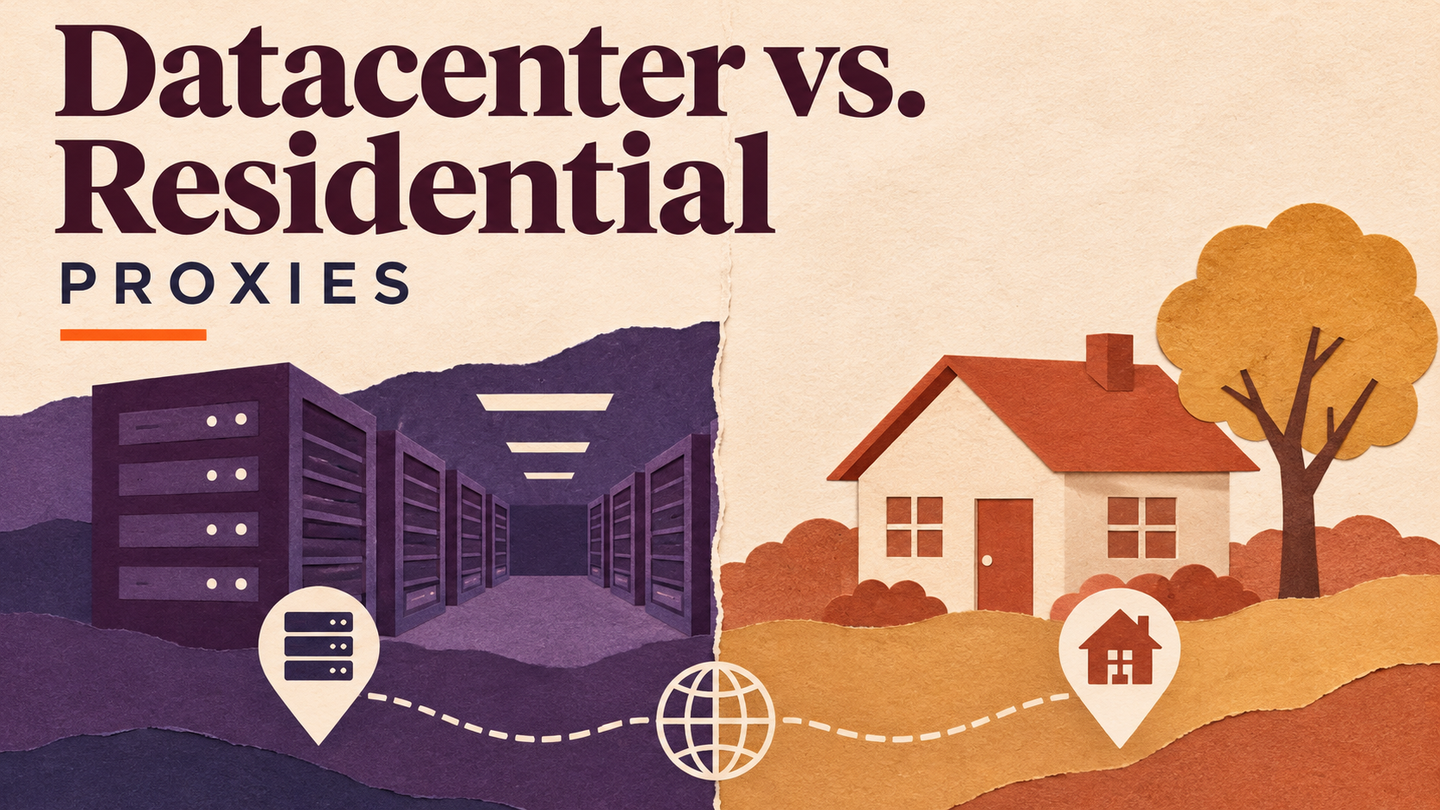
Datacenter and residential proxies differ in where a request exits the network and how the service allocates capacity. A datacenter route generally uses hosted infrastructure; a residential route uses a household connection. Those facts can affect location, continuity, throughput and how a destination responds, but the label alone predicts neither a successful fetch nor a trustworthy dataset. The useful question is: which route produces the required valid result within your permitted workload and budget?
1. Define the route and the task separately
Arcvenza Datacenter Proxies offer persistent endpoints through hosted infrastructure, with shared and dedicated allocation options. Arcvenza Residential Proxies route through household-network IPs and support rotating or persistent sessions. Both support HTTP(S) and SOCKS5, according to their product documentation. A datacenter proxy is therefore a network route, not a browser, crawler, or guarantee that a site will accept a request. A residential route also does not grant access rights or make every IP equally reliable.
Write down the task before comparing plans. A health check for your own site, a repeatable public-page regression test, and a local-market content study impose different demands. Decide whether the result requires a particular country or city, whether the same IP must persist across a multi-step journey, how many useful pages are needed per day, and what constitutes an acceptable page. Only then compare routes.
2. Compare capabilities at the level that matters
The current Datacenter pricing page describes IP-quantity plans with a 30-day service term, persistent assignments and shared or dedicated pools. The Residential pricing page describes traffic-based packages whose unused balance does not expire, with rotating or persistent sessions and country, state or city controls where available. These are different billing units; a direct price-per-IP versus price-per-GB comparison is not meaningful without a workload model.
| Decision factor | Datacenter route | Residential route | What to verify |
|---|---|---|---|
| Network origin | Hosted infrastructure | Household-network connection | Does the task require a specific network context? |
| Address continuity | Persistent assigned endpoint during active plan | Rotation or a persistent session | How long must one observation keep its route? |
| Location | Available countries in allocated pool | Country; finer targeting where covered | Does the returned page reflect the intended market? |
| Allocation | Shared or dedicated IP plan | Traffic-backed access to a rotating pool | Are exclusivity or breadth actually required? |
| Billing basis | IP quantity and plan term | Transferred traffic | What is cost per accepted result? |
Treat this table as a purchasing checklist, not a universal ranking. Coverage, plan terms and source behavior can change. “Dedicated” describes an allocation arrangement; it does not itself certify that a destination will regard an IP as reputable.
3. Interpret ASN and IP classification with care
An origin ASN tells you which network announces an IP prefix, not whether every endpoint behind it is a household device. The RIPEstat Network Info API returns the announced prefix and origin ASN observed for an IP. This is a useful independent check that the route is what you intended to test. It is not a complete proxy-type or reputation classifier: hosting firms, access providers, resellers and mixed-purpose networks can complicate labels.
Record the observed IP, prefix, origin ASN, country assertion and timestamp for a sample of endpoints. Compare that evidence with the provider's product and your target page's visible market. A city shown by an IP database is not proof that the page served city-specific content. Likewise, an IP appearing to belong to a consumer ISP does not prove that one stable household or person stands behind it. Keep network identity, claimed geography and actual page outcome as separate fields in the dataset.
4. Choose sessions and concurrency deliberately
Datacenter endpoints suit a test that benefits from a repeatable egress IP, such as comparing successive public versions of your own page or running an authorized integration check. Dedicated allocation may be useful when exclusive assignment matters. A shared plan can be sufficient when it does not. Residential rotation suits independent, permitted observations across available regions; a persistent residential session suits a multi-page sequence whose state must remain consistent. Neither strategy should rotate an IP in response to every failure without diagnosing the failure first.
Keep cookies, browser version, language, viewport, target URL, timeout and request cadence under control. When testing one variable, change one variable: first compare routes with the same client context, then separately test browser or market settings. Limit concurrent requests to what the source permits. A 429 Too Many Requests response is a rate-limit signal, and RFC 6585 allows a Retry-After hint; honor it rather than treating more IPs as a solution. For automated collection, respect the source's terms and robots rules.
5. Calculate the cost of a valid result
Run a small paired pilot on authorized targets at the same times. Define an accepted result before the test: for example, HTTP success plus the expected market, a complete key field, and a fresh timestamp. Log connect errors, response status, challenges, wrong-market pages, transferred bytes, end-to-end latency and accepted results. Compute p95 latency only across a clearly named population; mixing timeouts and successful pages without explanation can mislead.
For the datacenter plan, allocate the actual plan cost to the test period and divide by accepted results, while recording unused IP capacity and renewal risk. For residential, use the provider's billed traffic and package terms, then divide the attributable cost by accepted results. Add operational effort if a route produces more manual review or retries. The formula is effective cost per accepted result = attributable proxy spend ÷ accepted results. If accepted results are zero, the cost is undefined and the route has failed the pilot; do not hide that case behind a low advertised unit price.
6. Make a conditional decision and review it
Choose datacenter when the measured task benefits from persistent hosted endpoints, available locations and predictable IP allocation. Choose residential when the measured task requires a household-network view, broader available location sampling or a rotating pool. If a source already provides an official API or licensed feed that answers the question, use that path when appropriate; a proxy is not a substitute for source permission or data-quality work.
Document the sample size, target mix, market, test dates, client settings, failure categories and plan assumptions behind the choice. Re-run the pilot when the target changes, the source's policy changes, or the workload moves to a different region. Arcvenza's Datacenter and Residential offerings provide different controls; your measured valid-result yield, not the proxy label, should determine the production route.
Official Standards & Technical Documentation
Arcvenza — Datacenter Proxies product details
Arcvenza — Datacenter Proxies plan and billing details
Arcvenza — Residential Proxies product details
Arcvenza — Residential Proxies traffic and validity
RIPEstat — Network Info API for prefix and origin ASN