


















Proxies for SEO Rank Tracking: A Measurement Framework for Local SERPs
Build a reliable local SEO rank dataset: define organic position, control market and device context, compare only like-for-like snapshots, and reconcile with Search Console.
 Written byNora



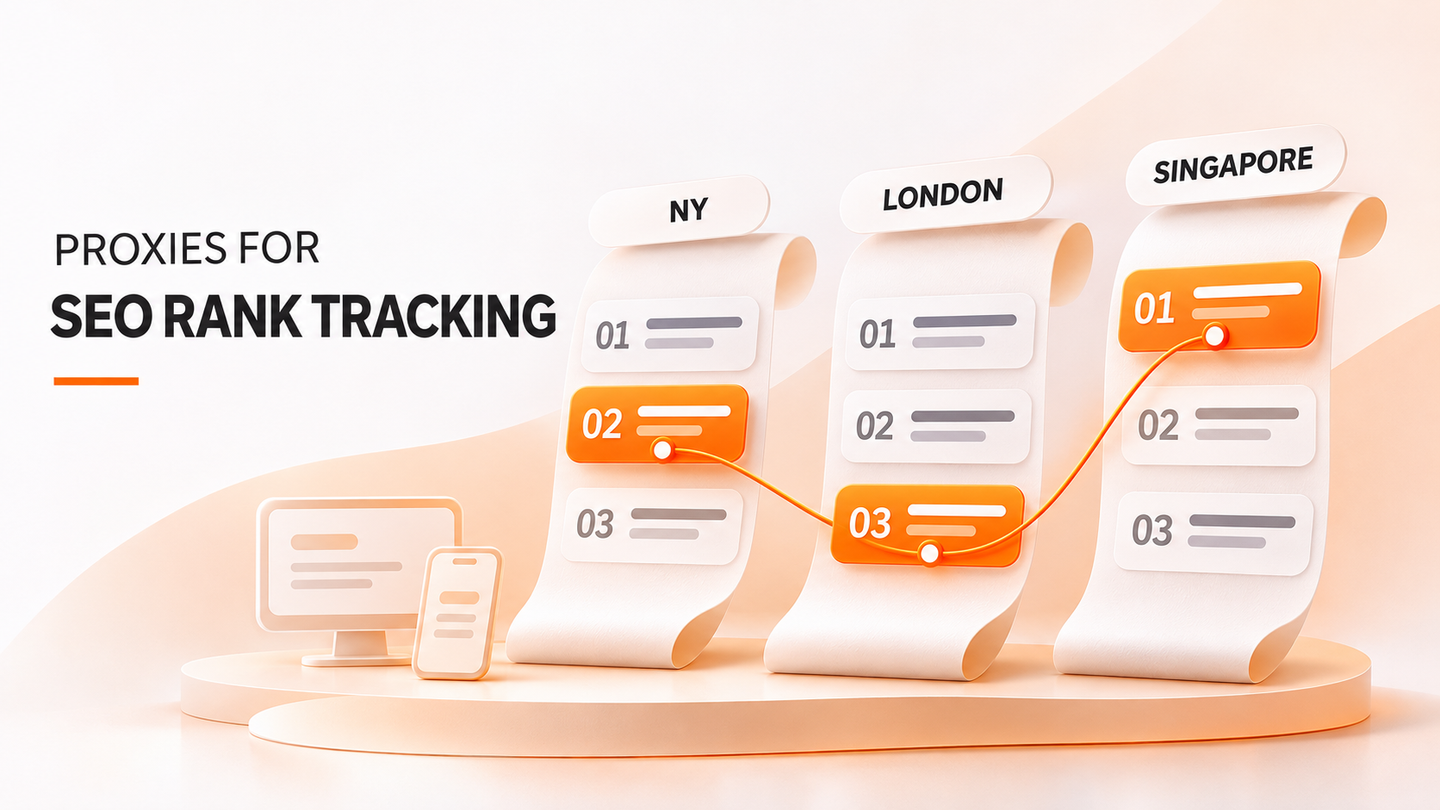
Rank tracking is useful only when the observation has a precise meaning. A result seen once from one network route is a local snapshot, not a universal position and not the same metric as Google Search Console's average position. This guide shows how to design an auditable, market-specific rank dataset, choose a suitable proxy route, and interpret changes without overstating what the data proves.
1. Define the rank you intend to measure
Write the measurement contract before collecting a result: search engine and search surface, exact query, target country or city, language, device, capture time, result window, and whether you mean an organic web result, a local-pack listing, a sponsored placement, or another feature. Also specify whether the entity being tracked is an exact URL, a page cluster, a host, or a business listing. These are different metrics.
Google explains that relevance can depend on location, language, and device, and the features shown can change with the query. Its Search Console position documentation adds an important distinction: the Performance report averages positions across impressions; for a property or page, it uses the topmost qualifying position in each result. A manually observed organic rank for one controlled query is therefore not a substitute for that average. Ads do not occupy a Google Search position under Google's published method, but a home-grown organic-only counter still need not reproduce every Search Console rule for rich elements.
Use Search Console for the performance of a site you control, including impressions and clicks. Use observed SERP snapshots for a defined market, competitor visibility, and feature composition. When the two disagree, first compare their query, country, device, date range, impression basis, and rank definitions; a disagreement alone does not imply bad proxy data.
2. Hold the search context still
A defensible local comparison changes one intended variable at a time. Keep the query spelling, engine, search surface, device class, browser locale, time window, result window, and collection method in the record. Use an isolated browser context or documented session policy so cookies and signed-in state do not silently change between runs. If the search provider offers supported market or language settings, record those too. Playwright's emulation documentation treats locale, timezone, geolocation, and device as separate controls; a proxy route changes the network exit, not all browser signals.
For city-level claims, record both the requested route granularity and the market the returned page actually indicates. A country-targeted IP is not evidence of city-specific results. Run a small pilot across two or three matched markets, with fresh and repeat sessions clearly labeled. Avoid treating an IP geolocation lookup as ground truth for the SERP that followed: a rotating route may use a different exit on the next request.
Timing matters as much as geography. Compare captures within a defined window, retain UTC timestamps, and note known search events or site changes. A ranking difference between a Monday mobile capture and a Friday desktop capture cannot be assigned to geography. Store the raw response or a permitted evidence artifact, parser version, and a checksum so a later analyst can reproduce why a rank was assigned.
3. Model the SERP before counting positions
Parse result types into separate collections. At minimum keep organic web links, sponsored results, local modules, and other visible features distinct. A featured snippet may contain a source link, and complex result elements can have position rules that differ from a simple list. Google's documentation explicitly says its position heuristics can change. Your own organic_position should be an operational definition with a parser version, never presented as an exact clone of Search Console position.
| Field | Example or rule | Why it matters |
|---|---|---|
| Context key | engine, surface, query, market, language, device | Prevents unlike snapshots from being compared |
| Capture evidence | UTC time, route ID, session state, parser version, artifact hash | Makes an observation auditable |
| Result identity | result type, observed URL, normalized host, feature label | Separates organic links from ads and modules |
| Position scope | organic-only index and observed result window | Makes “not seen” different from “not ranked” |
| Quality state | success, partial, blocked, layout changed, parse failed | Keeps failures out of movement charts |
Keep the observed URL and the matching rule side by side. A substring search for a brand name inside a URL can misidentify a competitor or a tracking link. For host-level reporting, parse the hostname and explicitly decide whether subdomains count. For page-level reporting, preserve the original URL and document any canonical or parameter normalization rather than stripping parameters blindly. Google may assign Search Console data to a canonical URL, another reason to avoid naive one-to-one comparisons.
4. Select a route for the observation design
Arcvenza Residential Proxies support location and session choices; they suit a matrix of independently sampled available markets. Use a rotating route for separate observations when independence matters. Use a persistent session when a permitted workflow has multiple steps and needs continuity. Record the actual route policy alongside every observation.
Arcvenza ISP Proxies provide assigned, stable endpoints in available country markets. They are useful for a repeatable baseline from the same network identity, provided that market inventory matches the study. Stability is a control variable, not a promise of a fixed ranking. A search engine can still change results for other reasons. If a structured SERP data product is available in your account, compare its documented fields and market controls with your measurement contract before building a browser parser; do not assume an API and a browser view have identical semantics.
Pilot route choice against accepted observations, not nominal request success: valid organic extraction, correct market evidence, full result window, and permitted access. Track cost per accepted snapshot and parser maintenance as well as network cost. Respect the search provider's terms, published access controls, and rate limits. An access denial is a reason to stop and review authorization, not to rotate identities until a request passes. HTTP 429 signals rate limiting; honor Retry-After when supplied, as described by HTTP semantics.
5. Compare only like-for-like snapshots
The following standard-library Python example analyzes already exported, authorized JSON snapshots. Each file contains engine, surface, query, market, language, device, result_window, captured_at, capture_status, and results. Set capture_status to complete only after validating the expected result window. Each result has type, position, and url. The code refuses incomplete or mismatched captures, limits matching to the exact host or its subdomains, and reports absence as not_observed_within_window, not a drop to an invented rank.
"""Compare two authorized, already-exported organic SERP snapshots."""

import json
import sys
from pathlib import Path
from urllib.parse import urlsplit

CONTEXT = ("engine", "surface", "query", "market", "language", "device", "result_window")


def load_snapshot(path):
    data = json.loads(Path(path).read_text(encoding="utf-8"))
    missing = [name for name in (*CONTEXT, "captured_at", "capture_status", "results") if name not in data]
    if missing:
        raise ValueError(f"{path}: missing {', '.join(missing)}")
    if not isinstance(data["result_window"], int) or data["result_window"] < 1:
        raise ValueError(f"{path}: result_window must be a positive integer")
    if data["capture_status"] != "complete":
        raise ValueError(f"{path}: capture must be complete before rank comparison")
    if not isinstance(data["results"], list):
        raise ValueError(f"{path}: results must be a list")
    return data


def host_position(snapshot, target_host):
    matches = []
    for item in snapshot["results"]:
        if item.get("type") != "organic":
            continue
        position = item.get("position")
        if not isinstance(position, int) or not 1 <= position <= snapshot["result_window"]:
            raise ValueError("organic result has an invalid position")
        host = (urlsplit(item.get("url", "")).hostname or "").lower().rstrip(".")
        if host == target_host or host.endswith("." + target_host):
            matches.append(position)
    return min(matches) if matches else None


def compare(before, after, target_host):
    if any(before[key] != after[key] for key in CONTEXT):
        raise ValueError("snapshot contexts differ; do not compare their positions")
    host = target_host.lower().rstrip(".")
    if not host or "/" in host or ":" in host:
        raise ValueError("target_host must be a hostname, not a URL")
    old, new = host_position(before, host), host_position(after, host)
    return {
        "target_host": host,
        "before": old if old is not None else "not_observed_within_window",
        "after": new if new is not None else "not_observed_within_window",
        "places_improved": old - new if old is not None and new is not None else None,
        "result_window": before["result_window"],
    }


if __name__ == "__main__":
    if len(sys.argv) != 4:
        raise SystemExit("usage: python compare_snapshots.py before.json after.json example.com")
    report = compare(load_snapshot(sys.argv[1]), load_snapshot(sys.argv[2]), sys.argv[3])
    print(json.dumps(report, indent=2))
Example input: two snapshots for the same query and market, each covering the top 20 observed organic results. If a target host is at 7 in the first and 4 in the second, the output reports a three-place improvement in this organic-only definition. If the host is absent from the second top-20 capture, its rank is unknown beyond that observed window. This code validates comparison logic; it does not fetch a SERP, identify Google-specific rich-result positions, or assert an observed Arcvenza performance figure.
6. Turn rank observations into decisions
Chart rank together with coverage and evidence quality. For each query-market-device cell, track the number of valid snapshots, missing or partial captures, observed organic rank when present, visibility within the fixed window, and changes in feature mix. Report uncertainty when a parser changed, a market selector was inconsistent, or a result type moved. A single jump is a prompt to inspect evidence; sustained movement across comparable captures is stronger evidence of a change.
For your own property, reconcile the directional story with Search Console's Performance report: segment by query, country, device, page, and dates, then examine impressions and clicks as well as average position. Those aggregates answer a different question from one local SERP. For a competitor, an observed rank has no companion Search Console dataset unless the property owner provides it. Keep any benchmark labeled by its actual scope.
Start with a small authorized market matrix, review examples by hand, lock a rank definition, and version every parser change. Expand only when the accepted-snapshot rate and market evidence support the decision. The operational aim is a trustworthy time series of comparable observations, not a large count of requests.
Official Standards & Technical Documentation
Arcvenza — Residential Proxies: location and session controls
Arcvenza — ISP Proxies: assigned stable endpoints
Google Search Central — How Search works
Google Search Console — Impressions, position and clicks
Google Search Console — Performance report
Playwright — Emulation of locale, device and geolocation