


















Proxies for Website Change Monitoring: Separate Real Updates from Regional Noise
Monitor meaningful website changes with stable proxy-market baselines, HTTP validators, semantic diffs and a confirmation step that reduces false alerts.
 Written byYiyao



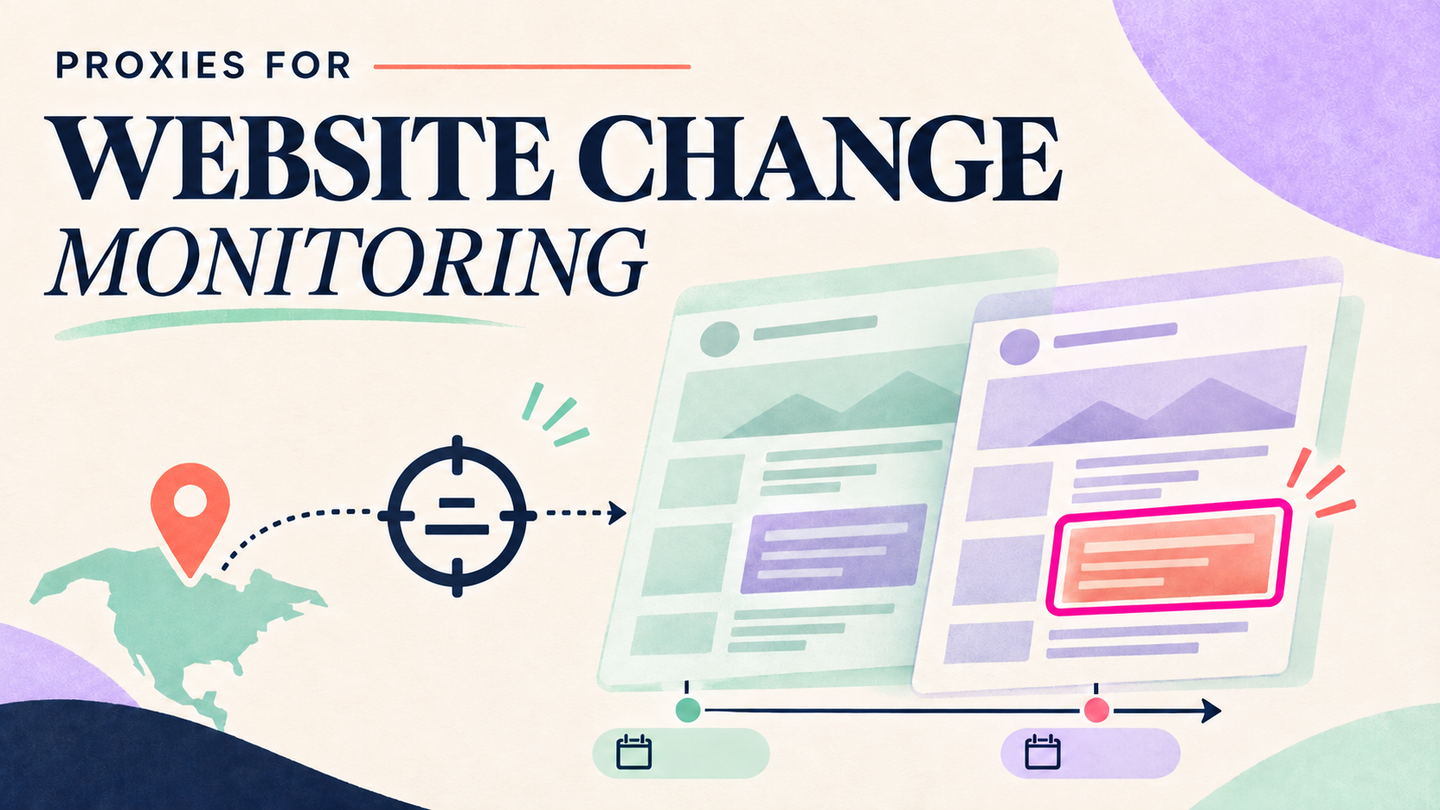
A page can look different because its content changed, but also because the observer changed country, language, cookie state, device viewport, or time of day. A website change monitor that compares two unrelated views will generate noisy alerts. Proxies help hold the network observation point constant or deliberately compare regional views. The useful output is a verified change to a defined piece of content, with enough evidence to reproduce it—not a raw HTML hash that changed.
1. Define the change event before choosing a proxy
Decide what matters: a policy revision, a newly available product, a changed shipping promise, a corrected knowledge-base paragraph, or a broken page. Write the target URL, field or page region, market, language, monitoring interval, and required confirmation rule. A visual redesign is not necessarily a product change; a price or availability update can occur without a large visual difference. Keep these event types separate.
Use an approved feed or API when a publisher provides one. For web pages, observe only sources you are permitted to access, respect terms and the site's Robots Exclusion Protocol rules, and limit request frequency. A proxy changes the request route; it does not create reuse rights or justify bypassing access controls. This matters especially when monitoring third-party sites at scale.
2. Make every snapshot comparable
Treat a snapshot as a tuple: canonical URL, timestamp, proxy route, verified market, language, relevant request headers, cookie/session state, browser version and viewport, and extraction version. Keep the tuple stable for a repeated baseline. If a site varies its response by Accept-Language, cookies, or other headers, an IP alone does not define the observed representation. HTTP's `Vary` field explicitly identifies request fields that influence a selected response.
Arcvenza ISP Proxies provide stable endpoints that fit a repeated baseline; Arcvenza Residential Proxies can supply regional household-network views where coverage supports them. For a multi-market study, create one baseline per market and record which route served each snapshot. Do not rotate the route inside one comparison unless route variation is the experiment itself.
| Source of apparent change | Control to hold constant | Evidence to record |
|---|---|---|
| Network market | Same verified proxy market for each baseline | Route ID and visible market cues |
| Language or currency | Same language, locale and site settings | Request headers and selected site locale |
| Personalization | Comparable anonymous or authorized session state | Cookie-jar policy and login state |
| Rendering | Same browser, viewport and wait condition | Browser version and rendered timestamp |
| Extraction | Versioned selector or parser | Raw permitted sample and parser version |
When the market itself is the question, compare synchronized snapshots from separate market baselines. A difference is then a regional variant, not automatically a newly published update.
3. Use HTTP validators without overreading them
For a page that provides an ETag or Last-Modified, a monitor can send a conditional GET with If-None-Match or If-Modified-Since. RFC 9110 defines these conditions and the 304 Not Modified response; it gives If-None-Match precedence when both conditions are present. A 304 can reduce transferred content, but it applies to the selected HTTP representation under that request's conditions. It is not proof that every regional, personalized, or client-rendered view is unchanged.
Store the validator alongside the request context that produced it. If the URL, market, language, authentication, or relevant Vary inputs change, treat it as a different baseline and fetch a full representation. Some pages have no validators or return weak or inconsistent ones; fall back to controlled full fetches and content-level comparison. RFC 9111 explains how caches revalidate stored responses; it is a useful technical reference, but your monitoring policy should be based on the actual source behavior you measure.
4. Compare the rendered page only when necessary
Many pages contain timestamps, recommendations, randomized IDs, and analytics markup that change without altering the content under watch. Extract a stable semantic record first: for example, product ID, price, currency, availability, shipping region and observed time. Normalize whitespace and stable units, then compare fields. Keep the original permitted page evidence so a reviewer can confirm that the extraction captured the intended element.
If the monitored field is loaded by JavaScript, render the page with a browser under a fixed wait condition, such as the appearance of the target element or completion of a relevant response. A fixed sleep alone can miss delayed data or wait needlessly. Playwright's network documentation describes observing page requests and responses; these events can help confirm that the expected data source loaded. Still record whether the page was rendered, because a rendered snapshot and raw HTML are different measurement methods.
5. Classify and confirm changes before alerting
Classify candidate changes as content update, regional variant, transient error, extraction failure, or access-state change. A 200 response containing a challenge page is not a successful content snapshot. A single missing field may be a parser break rather than a deletion. Require a second observation or a source-provided update signal for high-impact alerts, and compare a small human-reviewed sample when changing selectors.
For rate pressure, follow the site's guidance and any Retry-After value. RFC 6585 defines 429 Too Many Requests. Back off or stop rather than cycling routes to continue at the same load. Log status code, redirect chain, response size, validator used, market, extraction outcome and the field-level diff. That audit trail lets an analyst explain why an alert fired.
6. Measure useful alerts, not pages fetched
Track confirmed-change precision (confirmed changes divided by alerts reviewed), median detection delay, missed-change rate on a sampled reference set, source coverage, cost per confirmed change and request load per source. Report these by market and target class. A monitor that sends fewer, well-supported alerts may be more useful than one that fetches more pages and produces false positives.
Use ISP proxies when a fixed network baseline is needed and residential proxies when an available household-market view is part of the question. Pair the route with stable request context, appropriate HTTP validation and semantic comparison. Scale only after the alert quality and source permissions have been checked on a small pilot.
Official Standards & Technical Documentation
Arcvenza — ISP Proxies stable endpoints
Arcvenza — Residential Proxies location and session controls
IETF — HTTP Semantics: conditional requests, Vary and 304 (RFC 9110)
IETF — HTTP Caching and revalidation (RFC 9111)
IETF — HTTP 429 Too Many Requests (RFC 6585)