


















Proxy Authentication: Username and Password vs. IP Allowlisting
Understand the difference between proxy credentials and source-IP allowlisting, including 407 diagnostics, shared NAT, secret handling and deployment checks.
 Written byNora



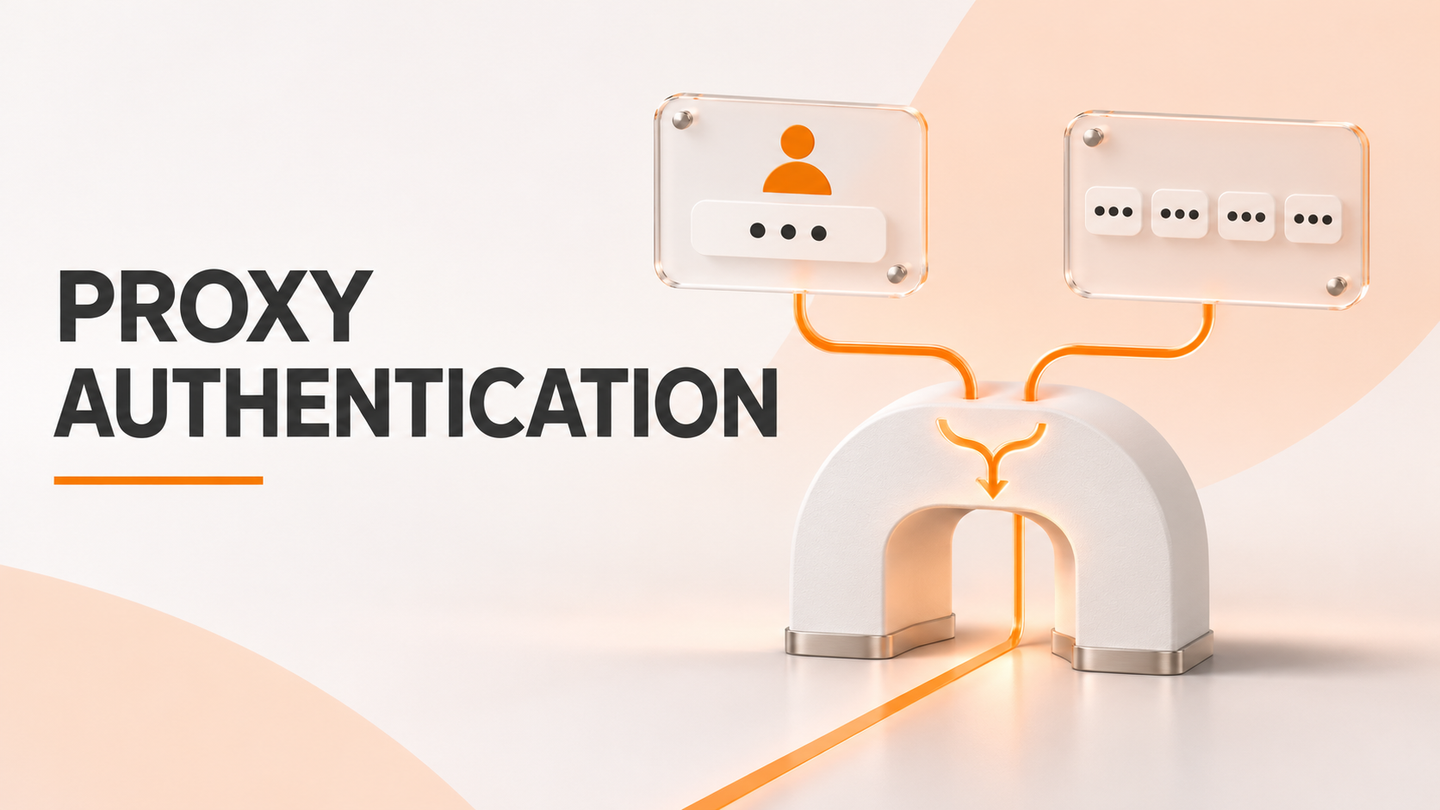
A proxy can be correctly configured for a target region and still fail before a request reaches the destination. Authentication happens at the proxy gateway, so the right diagnostic question is which client is allowed to connect and how that permission is checked. This guide compares credential authentication with source-IP allowlisting and gives teams a repeatable way to choose, secure and troubleshoot either method.
1. Identify which hop is rejecting the request
In an HTTP proxy flow, the client first connects to the proxy, then the proxy forwards or tunnels the request toward the target. HTTP Semantics (RFC 9110) defines Proxy-Authenticate and Proxy-Authorization for this proxy-specific challenge. A 407 Proxy Authentication Required response means the proxy requires valid authentication before fulfilling the request. It is different from a 401 challenge issued by the destination server. A destination's 403 or 429 is a different problem again; changing proxy credentials will not necessarily resolve it.
First record the proxy endpoint and port, chosen protocol, authentication mode, client machine or runner, and exact error stage. A TCP connection failure, a TLS validation error, a 407 response and a target response are four different signals. Do not reduce them to “proxy down.” If the response comes from a gateway, inspect the documented authentication method for that account; if it comes from the target, investigate the target's access and rate policy instead.
An HTTPS request through a proxy commonly uses a CONNECT tunnel, but the proxy still must authorize the client before the tunnel is established. Credentials intended for the proxy belong to the proxy configuration, not the destination website's Authorization header. Avoid printing proxy headers or complete proxy URLs in shared logs.
2. Compare the two authentication controls
With username and password, the client presents account credentials to the gateway. This fits laptops, mobile workers and hosted jobs whose public source IP can change, but the secret must be stored and rotated safely. With source-IP allowlisting, the provider accepts connections from specified public source addresses. The approved address is the client's egress toward the proxy gateway, not the proxy's exit IP seen by the destination website. An allowlist simplifies some machine-to-machine setups, but it does not identify which process behind a shared NAT made the request.
| Decision factor | Username and password | Source-IP allowlist |
|---|---|---|
| Client source IP changes | Usually practical if credentials remain valid | Requires an updated approved egress address |
| Secret in the client | Required; use a secret store and redacted logs | Not required for this gateway control |
| Shared NAT or team network | Per-client credentials can improve attribution if supported | Any permitted workload behind the same egress may connect |
| Hosted runner deployment | Works with changing egress if secrets are managed | Best when the runner has a known, stable public egress |
| Primary failure clue | Missing, expired or mismatched credentials; wrong endpoint | Wrong public source IP, changed NAT or stale allowlist |
Neither method is a complete security program. An allowlisted address can be shared or reassigned; a credential can be copied or leaked. Apply least privilege, account-specific access where available, and monitoring appropriate to the workload. RFC 7617 notes that HTTP Basic carries a Base64-encoded user/password pair rather than encryption, so transport protection and secret handling matter. Do not assume every provider or protocol uses Basic in the same way.
3. Match the method to the real deployment
For a developer laptop or autoscaled job with changing outbound addresses, credentials are usually easier to operate. Store them in the platform's secret manager, limit who can retrieve them, and rotate on an incident or scheduled policy. For a dedicated server with a stable public egress, allowlisting can reduce credential distribution. Record the actual public address of the runtime sending traffic to the proxy; a laptop, container platform and cloud NAT may present different addresses.
Arcvenza's Residential Proxies and ISP Proxies describe credential-based and source-IP-allowlist authentication in their product setup. Confirm the options in the current account and copy the endpoint, protocol and authentication details from the same configuration. A username or allowlist from one product setup should not be paired with another product's gateway. Proxy product selection—rotating residential versus assigned ISP endpoint—is a separate choice from authentication mode.
When several jobs share one NAT, do not call a source-IP allowlist “per-user authentication.” Restrict which jobs may reach the gateway and use provider-side account controls where available. When using credentials, do not place them in the URL of a committed source file, a screenshot, a ticket or an unredacted command line. OWASP's Secrets Management guidance is the right reference for storage, access and rotation practices.
4. Diagnose 407 without hiding the cause
Use a small, authorized test target such as https://example.com/ and make one request through the configured proxy client. First check that the selected endpoint is reachable and the client uses the intended proxy protocol. Then inspect whether the response is 407 from the proxy. If credentials are selected, verify the account, username, password, character encoding and product-specific endpoint together; do not paste a secret into a public diagnostic tool. If allowlisting is selected, verify the public source IP of the actual runner and that it appears in the correct product's allowlist.
Re-run only after changing one cause. Record status, timestamp, endpoint label and runner label, but redact credentials and full proxy URLs. A 407 after a successful earlier run can follow a changed source egress, rotated secret, expired access or a different runner. A successful request to an IP-echo service proves only that that request used a route; it does not prove the next rotating request has the same exit IP or that the target's own access policy will accept it.
If the proxy challenge continues after the account settings match, collect a sanitized reproduction and contact the provider. Do not respond by cycling through identities or bypassing a target's explicit denial. For a target-side 401, 403 or 429, move the investigation to the target's authentication, permission or rate-limit policy rather than the gateway allowlist.
5. Validate the result, not only the handshake
A connected proxy and a 200 response from a demo page are useful first checks, but they do not prove the intended application works. Run a small permitted workflow and verify target content, chosen market, session continuity, elapsed time and accepted-record yield. Test the same application from the actual deployment environment rather than only a personal laptop. If the gateway is allowlisted, a local success cannot establish that a cloud worker's outbound IP is approved.
Keep diagnostic layers separate: connection (can the client reach the gateway?), authorization (does the gateway accept it?), routing (does the request use the intended product and location?), and application output (does the target return the required data?). This separation avoids a common error: replacing a working proxy because the site selected the wrong language, or blaming a site for a 407 that occurred before the site was contacted.
For production, monitor 407 rates by endpoint and runner, but avoid logging username/password values. Track source-IP changes for allowlisted infrastructure and secret-rotation events for credential clients. A planned switch between methods should be tested in a staging worker first, then rolled out with an explicit rollback path.
6. Make the choice reversible and auditable
Choose credentials when source networks change frequently and your team can manage secrets well. Choose source-IP allowlisting when a controlled workload has stable public egress and you can restrict all processes behind it. If the account permits both methods, document which one each application actually uses; do not assume their precedence or combine them without checking the provider's current behavior.
Write down the endpoint, approved source or secret owner, rotation process, test target, expected response and escalation path. Keep this record separate from the secret itself. In an incident, the first question should be “which hop failed?” followed by the smallest test that distinguishes wrong endpoint, wrong credential, wrong source IP and target-side denial.
Summary: proxy authentication is an ingress control at the gateway. A good configuration is one the deployed client can use consistently, that can be audited without exposing credentials, and that can be changed without confusing a route problem with an application problem.
Official Standards & Technical Documentation
Arcvenza — Residential Proxies authentication
Arcvenza — ISP Proxies authentication
IETF — Proxy authentication (RFC 9110)
IETF — CONNECT tunneling (RFC 9110)