


















Unlimited vs. Pay-Per-GB Residential Proxies: A Capacity and Cost Model
Compare pay-per-GB and fixed-window Unlimited Residential plans using measured billable traffic, peak throughput and cost per accepted result.
 Written byNora



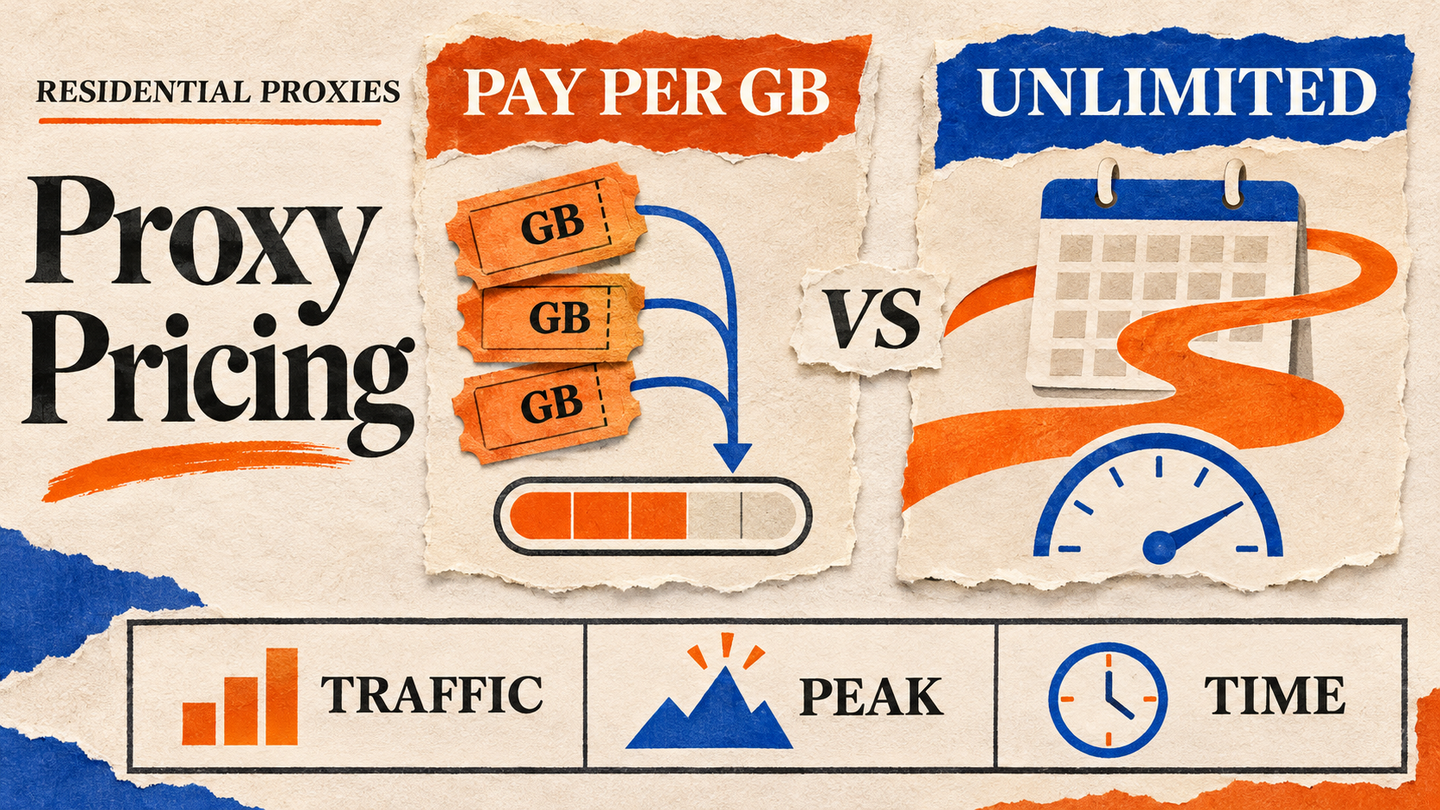
“Unlimited” and “pay per GB” describe different purchasing contracts, not two levels of proxy quality. A fixed-time plan can make a continuous job's spend predictable; a traffic balance can fit an irregular job whose usage is hard to schedule. The useful question is whether the workload fits the plan's time, bandwidth and route controls at an acceptable cost per valid result. This guide sets out a measurement and decision model without assuming that the lowest advertised unit price is the best purchase.
1. Read the contract before comparing the price
Arcvenza's Residential Proxies pricing bills transferred GB, and its current page says purchased traffic does not expire. A small experiment can therefore consume a balance over more than one calendar month. Unlimited Residential Proxies instead reserve an access window and a selected dedicated bandwidth tier at a fixed plan price, with no per-GB charge during that window. “Unlimited” refers to the absence of transferred-GB billing within the purchased term; it does not remove the term or the bandwidth constraint.
Check the current Unlimited pricing page for the available windows, tiers, renewal behavior and total checkout price. Confirm the exact bandwidth unit and capacity in checkout or with sales before designing a high-throughput job. Prices and terms can change; use a dated quote for a purchasing decision.
The two plans also need to be functionally comparable. Confirm country or city availability, HTTP(S) or SOCKS5 needs, rotation and persistent-session behavior, authentication, concurrency, support and acceptable-use terms. A plan that cannot reach the required market or maintain the required session is not cheaper simply because its invoice is smaller.
2. Measure traffic and useful output from a representative pilot
Choose a permitted sample that includes typical pages, the heaviest pages, the markets and the client mode you expect to operate. Log attempted requests, accepted records, response size distribution, retry reasons, elapsed time and actual billed traffic shown in the provider dashboard. A browser workflow with images and scripts may consume materially more data than a narrow HTTP fetch. One successful demo page is not an adequate traffic estimate.
Do not calculate billable GB by summing only HTTP Content-Length. RFC 9110 defines that field as representation-data length for the message, not as a proxy provider's billing ledger; some responses lack it, and a browser can fetch multiple resources. Use the provider's usage report as the billable measure, reconcile it with client observations, and state whether upload, download, retries and failed responses are included under the current contract.
Record peak transfer rate as well as monthly GB. A job can transfer a modest total but still need a high short-lived rate, or move many GB over a long window at a low average rate. Measure the busiest interval and concurrent connections, then leave headroom for retries and the target's rate policy. A theoretical bandwidth ceiling is not a promise of accepted site data.
3. Match the pricing shape to the workload shape
The table is a screening tool. It does not replace a route-specific pilot or the current commercial terms.
| Workload pattern | Pay-per-GB balance tends to fit | Fixed-time Unlimited plan tends to fit | Check before choosing |
|---|---|---|---|
| Infrequent research or testing | Traffic is used only when needed; unused Arcvenza Residential balance currently does not expire | A reserved window may end while the job is idle | Minimum spend, expiry and cancellation terms |
| Predictable continuous monitoring | Cost grows with transferred data | Total spend is known for the selected term and bandwidth tier | Peak throughput, renewal and uptime of the job |
| Short, intensive collection campaign | Useful if the volume is still uncertain | Useful when the complete run fits a purchased window | Whether the chosen tier can finish before expiry |
| Browser-heavy or media-rich pages | Larger and less stable traffic bill | No per-GB fee during the term | Bandwidth, target behavior and accepted-result yield |
| Many markets with uneven demand | A shared traffic balance can absorb irregular usage | Multiple windows or tiers may be needed | Market coverage and scheduling overlap |
Do not equate “unlimited concurrent sessions” in a different provider's marketing with unlimited useful throughput. Likewise, a fixed price is not a guarantee of success on every target. Count successful, policy-compliant records that pass the same data validation rules under both options.
4. Calculate a break-even point, then test the capacity constraint
Let F be the quoted fixed-window price, p the applicable pay-per-GB price and G the projected billable GB within that same window. The simple spend comparison is F versus p × G; the nominal break-even volume is G* = F / p. For an illustrative, invented example, if F = $600 and p = $3/GB, break-even is 200 GB. At 240 GB, the arithmetic is $600 versus $720. Those numbers are not Arcvenza prices or measured performance.
That arithmetic is valid only if the fixed plan's selected tier handles the real peak load, the access window contains the whole run, and both routes meet the same market and session requirements. If a campaign spills into a second window, include that second plan. If a pay-per-GB purchase remains usable after the campaign, treat the unused balance as future capacity rather than pretending it was consumed in this month's comparison.
For an operational decision, divide total relevant cost by accepted records, not by attempted requests. Include plan fees, extra windows, unused traffic that cannot be redeployed, and the labor or infrastructure cost of retries where meaningful. Keep the acceptance rule identical: correct market, complete fields, fresh response and permitted access. Lower price per GB can lose when repeated large responses produce few usable records.
5. Run a controlled comparison on the same job
Test both plans on the same authorized targets, market mix, time period, client configuration and parser version. Use separate labeled runs and keep route behavior explicit. Compare accepted-record yield, billable GB, peak observed rate, p50/p95 elapsed time, and total spend projected from the current quote. A fixed-window trial should be long enough to include the real peak period; a traffic pilot should include failures and retries rather than only the cleanest pages.
Separate site-side limits from proxy capacity. RFC 6585 defines HTTP 429 for too many requests; follow the site's policy and Retry-After when supplied. More bandwidth does not override a target's access rules. Do not use a proxy plan as a way to evade an explicit denial. If two tests encounter different site conditions, mark the comparison inconclusive instead of forcing a winner.
Keep a one-page evidence sheet: date, price source, chosen tier, window, route settings, targets, volume, accepted results, exclusions and the operator who reviewed the data. This makes the recommendation reproducible when prices, traffic or site behavior change.
6. Make the decision reversible
Choose a traffic balance when use is sparse or uncertain and the non-expiring balance can serve later jobs. Choose a fixed window when the workload is sustained, its start and end are known, peak throughput fits the selected tier, and a predictable invoice matters. A hybrid is reasonable: use a small traffic balance for development and a fixed window for a proven campaign, if the account and workflow support both.
Revisit the choice when the parser starts loading more assets, the target mix changes, the job becomes burstier, or the required market coverage shifts. Preserve the pilot's accepted-result metric as the common yardstick. The best plan is the one that delivers valid data within the operational window at a cost your team can defend, with the limits of the plan written down before purchase.
Official Standards & Technical Documentation
Arcvenza — Residential Proxies product details
Arcvenza — Residential Proxies pricing and traffic validity
Arcvenza — Unlimited Residential Proxies access model
Arcvenza — Unlimited Residential Proxies pricing